

Nicolás Medina Mora’s tour de force exudes narrative precision, making it a worthy successor to the post-Bolaño boom, as it employs an expansive technique to inquire into the condition of an all-encompassing Mexican national identity. Its protagonist, Sebastián Arteaga y Salazar, embarks on a series of metaphysical forays that reflect an inner struggle with belonging amid generational migratory currents.
The prevalence of the angst elicited by “white privilege” in much of the plot permits the narrator to adopt a sarcastic, self-deprecating stance toward his perceived social precariousness. In addition, the story’s style emphasizes the confrontation between canonical traditions and swings toward a quirky, experimental portrayal of young-adult, hipster-like life patterns. It thus showcases, at once, an erudite handling of referential support across philosophical, historical, and poetic currents, as the author imbues the plotline with a dose of autobiographical elements.
The fact that it is written in English also provides a wider range of expressive possibilities for appreciating the author’s adaptability, given how Sebastián runs an inexorable race toward literary self-realization. The reader is taken on a rollercoaster ride of unhinged emotional swings due to explosive relationships, almost always through an underlying sense that generational trauma could come back to bite him at the least expected moment.
Another salient feature of the novel is its vignette-like development, with sections marked as sub-headers that give us an overall sense of what the action will be about. This technique is also a reminder that a pseudo-journalistic method can convey a wide array of communicative quests, as the protagonist thirsts for spiritual fulfillment in his alternating wanderings through New York City, Mexico City, and Iowa. The three main hubs of the story’s unfolding hold more than a sentimental edge for the author: they become the primal grounds for the evolution of a voice that trembles between obsessions with cultural assimilation and propensities to bask in an ever-elusive artistic limelight. Nevertheless, the bravado that Sebastián personifies demands considerate attention to disentangle the convoluted coordinates of his dealings with the other meaningful characters.
All in all, the novel charts the lineage of a broader population across the continent, as its title reimagines the battle between those at the center and those left on the margins. It accesses realms of experience presented in a non-linear manner, yet still embedded in a kaleidoscopic continuum that could only be the product of embellished art. América del Norte thus becomes that which is fashioned by the Other, the outsider; albeit in his endless striving to undermine such differences, we might come across a sliver of hope for humanity and, at last, combat hate and misunderstanding. This is, in essence, what is left as a feat of the reader’s imagination in conjunction with the author’s expansive reflexiveness.

América del Norte de Nicolás Medina Mora
SoHo Press, New York, 2024.
[Inédit en français]
A propos

 La revue par-delà les océans
  Club de lecture autour de l’écrivain mexicain Jorge Volpi
  Le #13 à l’honneur demain
  Grande soirée France-Mexique, 200 ans de relations diplomatiques
 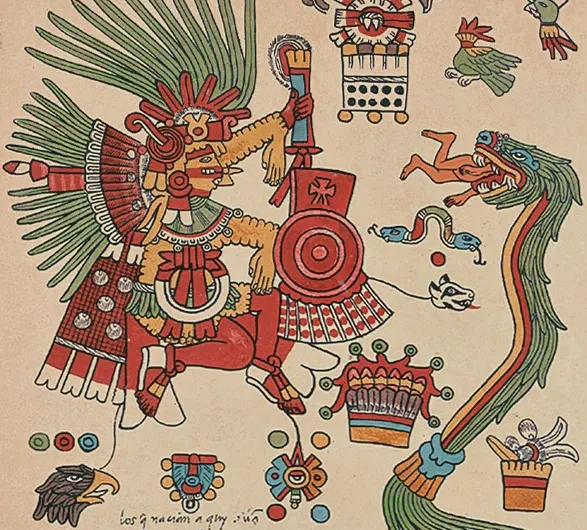 Les Codex mexicains font de la diplomatie
  Editorial – Le Mexique